
By Mahe Salah | Zyneri Global Solutions
Sourcing products internationally can open new opportunities for your business. But before you pay a supplier, it helps to look beyond the product photos and quoted price.
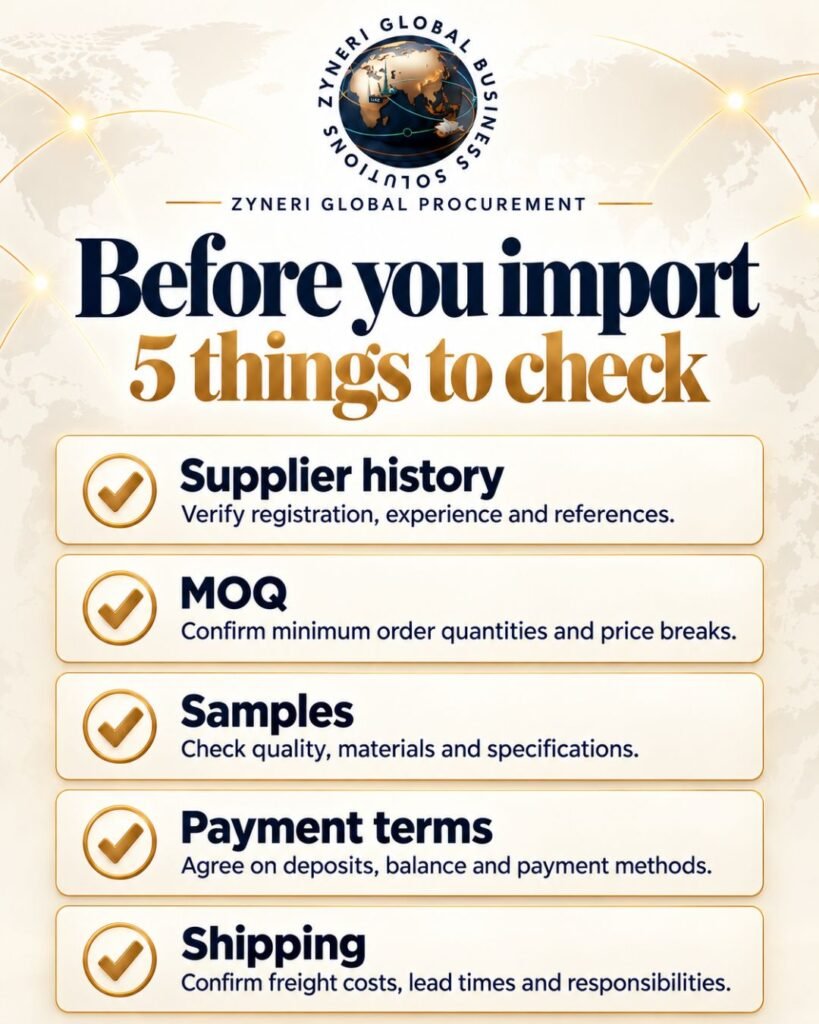
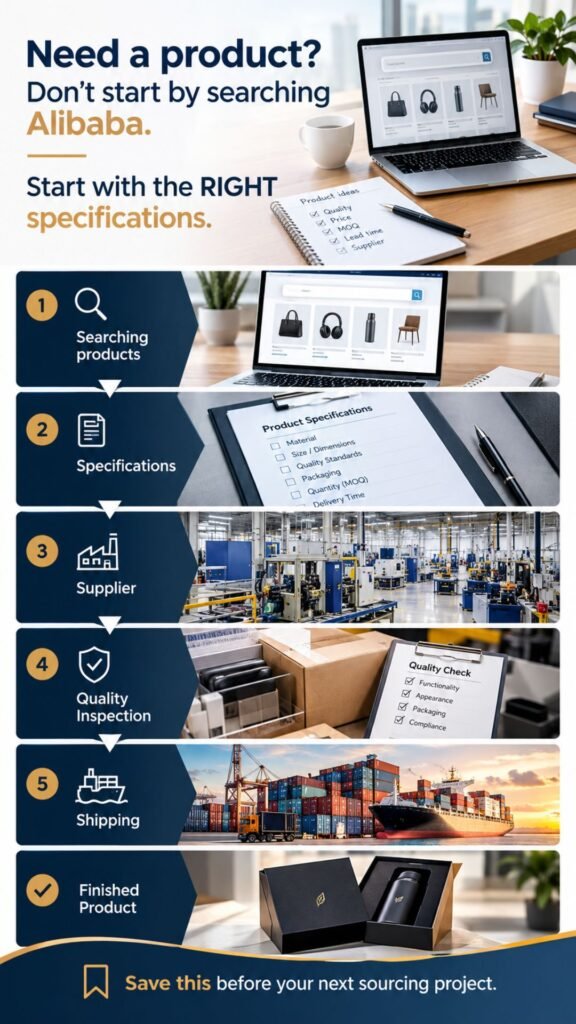
Whether you are starting a side hustle, launching an online store or expanding an established business, five checks deserve your attention: supplier history, minimum order quantities, samples, payment terms and shipping.
This checklist is a starting point for SMEs exploring suppliers in China, Dubai and other international markets.
A professional website or marketplace profile is useful, but it does not tell you everything about a supplier.
Start by confirming the supplier’s legal business name, registration details, location and experience with your product category. Establish whether you are dealing with a manufacturer, wholesaler or trading company.
Ask:
A trading company can be a suitable partner. What matters is understanding its role, capabilities and responsibility for your order.
Before proceeding: Check that the quotation, invoice and payment beneficiary details are consistent. Investigate unexplained differences.
MOQ means minimum order quantity: the smallest order a supplier is willing to accept under its stated terms.
Confirm whether the minimum applies to the whole order or separately to each colour, size, design or customised product.
Ask:
A lower unit price can become expensive if it requires buying more stock than you can realistically sell.
For example, 1,000 units at $3 each require $3,000 in product spending. A trial order of 200 units at $4 each requires $800. These illustrative figures exclude freight and other costs, but show why the cheapest unit price is not always the best first-order decision.
Before proceeding: Match the quantity to your budget, storage space and expected demand.
Product photos cannot fully show material quality, finish, sizing or performance.
Request samples and compare them against written specifications. Depending on the product, check dimensions, materials, colour, functionality, branding and packaging.
Ask:
Keep an approved sample and record the specifications you agreed on. A good sample is a reference point; it does not guarantee that every item in a production run will match.
For products sold in Australia, also check applicable safety requirements. The ACCC explains that sample testing alone may be insufficient without further quality assurance.
Before proceeding: Agree on how production quality will be checked before shipment.
Clear payment terms should explain how much you pay, when you pay and what happens if the order does not meet the agreement.
Ask:
Keep the agreed product specifications, quantities, delivery commitments and payment terms together in writing.
If bank details change, verify the change through an independently confirmed contact channel before transferring money.
Before proceeding: Make sure you understand the payment method’s protections, limitations and dispute process.
The supplier’s product price is only one part of the purchasing decision.
Build a cost estimate that considers the goods, packaging, freight, insurance, clearance charges, applicable duties and taxes, and delivery to your destination. Australian Border Force provides guidance on import duties, GST and other potential charges.
Ask:
Separate production time from shipping time when planning a launch.
Before proceeding: Get a written breakdown of costs and responsibilities, rather than relying on “shipping included”.
These five commercial checks do not replace product-specific import checks.
For Australia, investigate relevant restrictions, permits, biosecurity conditions and mandatory product standards before committing to an order. Requirements depend on the goods. Business.gov.au provides a useful starting point for Australian importers.
Yes, where supplier quantities, costs and product requirements suit the business. Ask about trial orders, existing stock and mixed-product options rather than assuming every supplier accepts small orders.
Buying directly means managing supplier research, communication and order coordination yourself. A sourcing agent can provide agreed support with those tasks. Before appointing one, clarify fees, deliverables, supplier relationships and responsibilities.
Not necessarily. Ask where the goods were manufactured and where they will be shipped from. The supplier’s location and the product’s origin can be different.
Zyneri Global Procurement supports entrepreneurs, retailers and SMEs with product sourcing, supplier research, procurement consulting, China sourcing and Dubai buying-agent services.
Whether you are exploring your first product or reviewing an existing supplier, start with a clear brief: your product, quantity, budget, destination and required delivery date.
Explore Zyneri’s global sourcing and procurement services, or message zynerifze@gmail.com with “SOURCE” to discuss your requirements.
Connecting Businesses. Building Trust. Creating Opportunities.

By Mahe Salah | Zyneri Global Procurement
A supplier offers the product you want at a price that looks almost too good to miss. The photos look professional, the potential profit margin looks promising, and you are ready to order.
But what does that quote actually include—and what could it cost your business if something goes wrong?
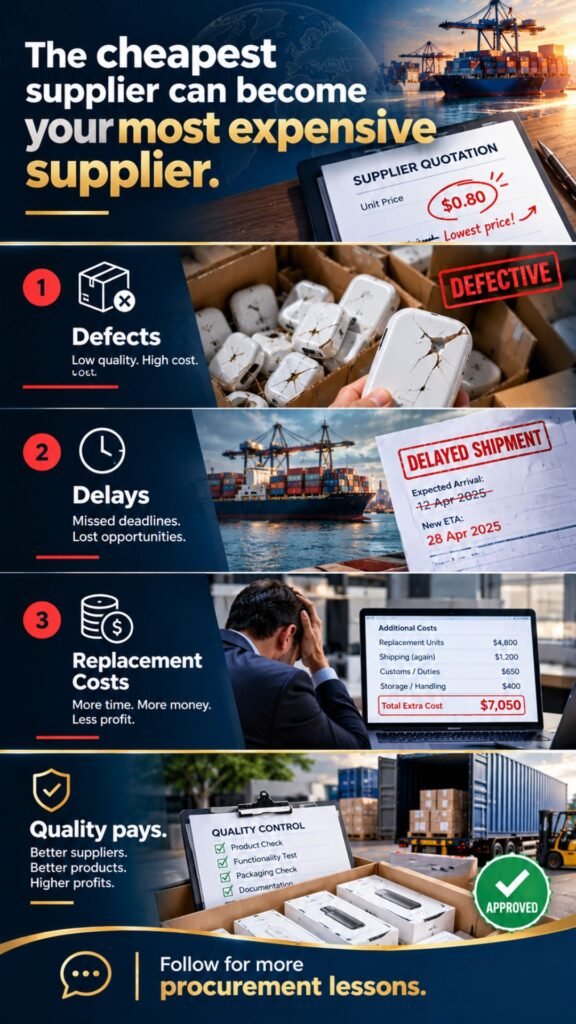
For small businesses, startups and entrepreneurs sourcing from China, Dubai or other international markets, price matters. However, the cheapest quote can become the most expensive mistake when quality, delivery and communication are overlooked.
A low price does not automatically mean a poor supplier. The key is understanding what you are buying and comparing suppliers on the same terms.
Two products can look almost identical in photographs while differing in materials, construction, finish or durability.
A cheaper quote might reflect thinner materials, simpler packaging or fewer quality checks. It could also reflect efficient manufacturing. Until you investigate, you cannot tell.
If the goods arrive below your requirements, the consequences may include:
What to check before ordering
Request a sample and compare it with written specifications. Confirm materials, dimensions, colours, functionality, branding and packaging.
Keep the approved sample as a reference and agree on how the bulk order will be inspected. A good sample does not guarantee that every item produced will match it.
If you are selling consumer products in Australia, check applicable safety requirements as well. The ACCC explains that pre-production sample testing may need to be supported by further quality assurance.
A product arriving late can disrupt your plans even when its quality is acceptable.
For a small business, delays might mean missing a market stall, seasonal promotion, customer deadline or product launch. You may also need to pay for faster freight or source replacement stock locally.
Before accepting a delivery promise, clarify what it means. “Ready in three weeks” might refer to production completion, rather than arrival at your business.
What to check before ordering
Ask the supplier to separate:
Confirm when the production timeline starts. Is it after the deposit, sample approval or final artwork approval?
Allow room for uncertainty when planning a launch, and ask how delays will be communicated.
A misunderstanding about colour, sizing, quantity or packaging can affect the entire shipment.
Phrases such as “premium quality”, “standard size” or “same as the photo” leave room for different interpretations. A supplier may believe it has met your expectations while you receive something you cannot use.
The issue is not simply how quickly a supplier replies. It is whether the answers are clear, complete and consistent.
What to check before ordering
Create a written order brief covering your requirements. Include measurements, material details, quantities, packaging and reference images where useful.
Ask the supplier to confirm the final version before production begins. Record any changes in writing, including their effect on pricing and timing.
A supplier willing to clarify details gives you a stronger foundation for managing the order.
A low unit price can look attractive because it covers fewer services or responsibilities.
One quote might include packaging and delivery to a specified destination. Another might cover only the goods at the supplier’s premises.
Before comparing prices, check whether each quotation includes:
Australian Border Force provides guidance on duties, GST and other import charges that may affect your cost estimate.
Compare the cost of receiving usable stock—not just the price printed beside each unit.
Imagine two suppliers quote for 500 units of a product:
| Cost | Supplier A | Supplier B |
|---|---|---|
| Price per unit | $4.00 | $4.50 |
| Product order total | $2,000 | $2,250 |
Supplier A appears to save you $250.
Now suppose that order requires $300 in rework and $150 in extra transport to resolve a quality issue. Its cost becomes $2,450—$200 more than Supplier B’s product order total.
This is an illustrative example, not a prediction about either supplier. It excludes standard freight, taxes and other costs. It shows how quickly an apparent saving can disappear.
Before placing an order, ask yourself:
You do not need to choose the most expensive supplier. You need enough information to judge whether the quoted price represents suitable value for your business.
Zyneri Global Procurement supports entrepreneurs, retailers and SMEs with product sourcing, supplier research, procurement consulting, China sourcing and Dubai buying-agent services.
If you are comparing suppliers or preparing your first overseas order, share your product requirements, quantity, budget, destination and delivery deadline.
Explore Zyneri’s global sourcing services or message @zynerifze with “SOURCE” to discuss your requirements.
Connecting Businesses. Building Trust. Creating Opportunities.


